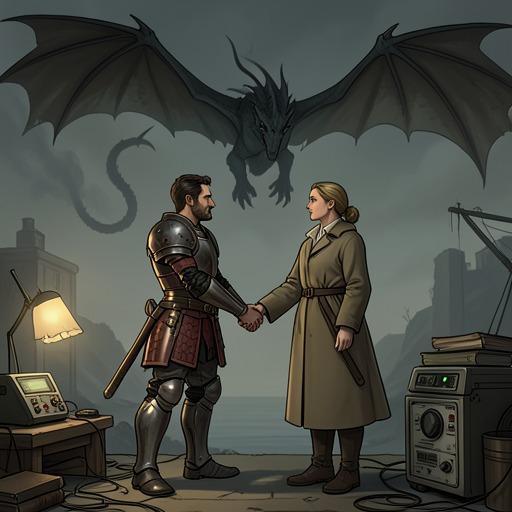
Vainqueur–Victor
Vainqueur the DragonVainqueur–Victor is the relationship between Vainqueur Knightsbane and Victor Dalton, an arrangement that joins imperial authority to practical service and eventually turns formal minionship into friendship. Its decisive tension is that Vainqueur expresses attachment through possession, loans, protection, and debt, while Victor responds with reliability, gratitude, endurance, and finally an independent commitment to remain beside his master even if the service contract ends.
Hierarchy, Service, and Trust
Vainqueur initially understands Victor as a manling minion whose value lies in dependable service. Victor is physically vulnerable by Vainqueur’s standards, unable even to survive fire, yet Vainqueur considers him worth preserving because he has been exemplary and reliable. When Vainqueur cannot use certain items himself, he agrees to loan wearable equipment to Victor, presenting the decision as limitless generosity and expecting thanks in return. Victor answers with a deep bow, making the exchange a miniature version of their entire bond: Vainqueur gives from a position of power, and Victor converts the gift into acknowledgment of rank.
The relationship is therefore never simple benevolence. Vainqueur repeatedly translates care into an account book. When Victor arranges the sale of corpses for necromantic transformation through the Church of Camilla, Vainqueur promises him a fee. Victor expects one-tenth of the sales, but Vainqueur deliberately reinterprets the agreement as one one-tenth and pays eight gold coins. The joke exposes the unequal terms beneath their cooperation: Victor performs morally uncomfortable work, while Vainqueur retains the authority to define its reward.
Yet Vainqueur’s possessiveness also produces genuine protection. He dislikes spreading his hoard beyond his sight and temporarily loans weapons to the Kobold Rangers so that the beauty of the treasure will encourage them to work. Victor receives a different status. Vainqueur declares that Victor alone is worthy to wield the sacred treasures in battle because he is the only servant Vainqueur fully trusts not to lose them. Trust is thus expressed through controlled access to wealth, and the chief of staff becomes the exceptional minion allowed closest to the dragon’s hoard.
From Minion to Friend
The decisive change occurs when Vainqueur promotes Victor to his first and only friend. Even this personal recognition is phrased as an imperial declaration and accompanied by a demand that Victor prove himself worthy of the honor. Victor initially hopes he is worthy, then corrects himself into a firm promise that he will be. The exchange marks a movement from imposed service toward chosen loyalty, but it does not abolish the old hierarchy; friendship is added to minionship rather than replacing it.
Vainqueur immediately folds the new intimacy back into debt. He forbids Victor from sleeping until Victor has repaid 12,545,133 gold coins, a sum said to include the life debt incurred when Vainqueur raised him as his prized chief of staff. Victor compares the burden to a student loan, yet accepts it with an unexpected peace. His willingness to keep working until both of them become gods shows that the relationship has become meaningful precisely through its mixture of absurd coercion and voluntary fidelity.
The contrast with Furibon makes the promotion especially revealing. Furibon, trapped inside Vainqueur’s scythe, reacts to the display of affection with disgust, treating the scene as nauseating sentimentality. Vainqueur and Victor, however, accept a bond that neither side describes in ordinary emotional language. The dragon calls it honor and debt; the human answers with service and resolve. Their friendship is therefore legible less through tenderness than through continued participation in a shared obligation.
Resurrection and Sacrificial Loyalty
Victor’s revival on Outremonde intensifies the relationship by making life itself part of its economy. The goddess Miel explains that mortals paid a generous church donation for Victor’s resurrection. Victor briefly considers whether Vainqueur might have paid, but rejects the possibility because the dragon would never surrender any coin; he concludes that the villagers of Murmurin must have pooled their funds instead. The scene distinguishes Vainqueur’s attachment from ordinary financial sacrifice while also showing how widely Victor’s value has spread beyond the two partners.
Although Vainqueur does not personally pay for the revival, he later presents Victor’s return as the greatest proof of his own greatness. Before the dragons, he boasts that he gathered a greater golden hoard and sacrificed it all to revive his greatest treasure, his prized, dragonized chief of staff. The statement turns Victor into both person and treasure. Victor kneels in gratitude while the minions cheer, “Vainqueur best dragon!” The public spectacle converts private loyalty into imperial propaganda: Vainqueur’s generosity establishes his prestige, and Victor’s restored existence becomes evidence of the dragon’s power and devotion.
This framing also reveals the relationship’s central contradiction. Victor is valued as a trusted companion, but Vainqueur describes him with the vocabulary of possession, calling him a treasure and presenting his dragonization as an achievement of the hoard. The bond reaches its most self-sacrificing form while still being articulated as ownership. Vainqueur can give everything for Victor and continue to imagine Victor as something that belongs to him.
Partnership in the Imperial Household
After Vainqueur’s promotion to Emperor, Victor remains the practical figure whom the ruler expects to summon, consult, and place at the center of public action. Vainqueur’s authority is theatrical and acquisitive, while Victor’s role is administrative and stabilizing. Their titles therefore complement one another: Emperor and Grand Vizier, master and chief of staff. Vainqueur supplies command, spectacle, and treasure; Victor makes the command workable through dependable service.
The relationship’s public dimension is visible after Vainqueur’s Bragging Day. The celebration leaves the surrounding area resembling the aftermath of a volcanic disaster, with houses overturned and no sheep left alive. Once the party ends, Vainqueur orders the Kobold Rangers, gnolls, mimics, and other servants to gather. His first concern is not the ruined landscape but Victor’s whereabouts, and he is ready to summon his trusty sidekick to his side. Even amid imperial disorder, Victor functions as the person whose presence restores the expected arrangement of the household.
That search also shows that Victor is no longer merely one minion among many. The servants can report where he may have gone, but Vainqueur specifically asks for him rather than issuing a general command. Victor’s absence becomes noticeable because the ruler’s authority and daily operations have come to depend on a particular individual. The chief of staff has become the irreplaceable human counterpart to the dragon’s oversized will.
Significance of the Bond
Vainqueur–Victor dramatizes a recurring exchange between material power and relational loyalty. Equipment, gold, resurrection, titles, protection, and access to the hoard all move from Vainqueur toward Victor, but each transfer creates or reinforces an obligation. Victor’s service, gratitude, and promise of continued companionship move back in the other direction. The bond resembles a contract, yet its most important development cannot be fully priced: Vainqueur’s declaration of friendship changes Victor from a useful subordinate into the person singled out as uniquely trusted.
The relationship also gives emotional shape to Vainqueur’s otherwise possessive character. Vainqueur does not become generous in a selfless sense; he continues to count coins, guard treasures, demand reimbursement, and describe Victor as property. Nevertheless, the scale of his protection and the prominence he grants Victor show that the dragon’s hoard has acquired a living center. Victor is the treasure Vainqueur is willing to display, loan weapons to, revive, dragonize, and defend as the embodiment of his own greatness.
For Victor, the relationship offers both burden and belonging. He is trapped beneath an enormous quantified debt and remains subject to Vainqueur’s commands, but he also receives recognition unavailable through ordinary employment: trusted access to sacred weapons, the title of chief of staff, resurrection into a new form, and the status of first and only friend. His final willingness to find a way to repay the debt and continue working until both partners become gods confirms that the relationship’s apparent absurdity has become a chosen life structure. Vainqueur–Victor endures because domination and loyalty, ownership and friendship, remain inseparable within it.